

Build More Refineries
The Pitch That Refuses to Die

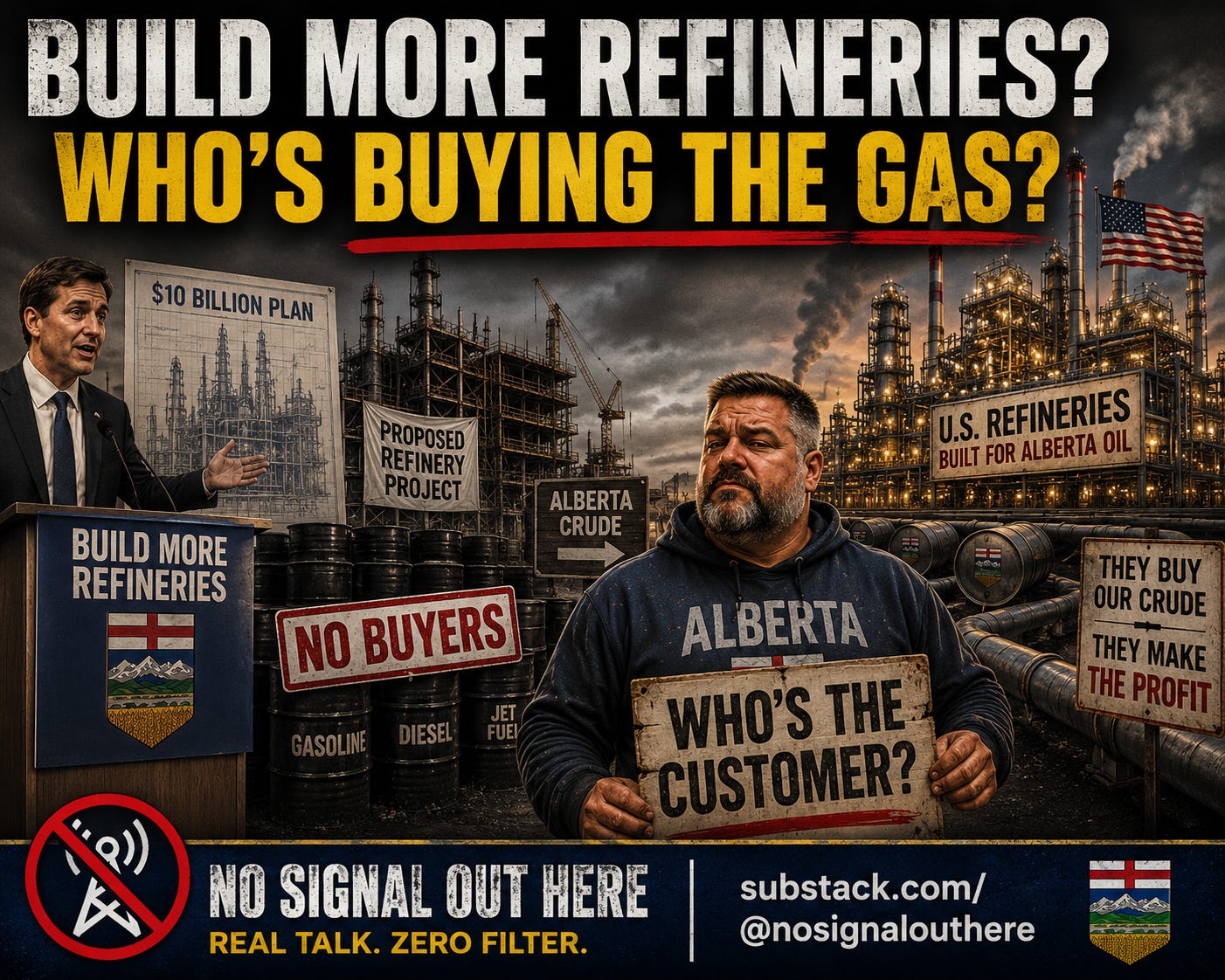
BC Premier David Eby spent part of January arguing that instead of building new pipelines, Canada should be building more refineries. Keep more value at home. Reduce reliance on US buyers. Cut exposure to global supply shocks.
It’s not a new idea. Rachel Notley pitched the same thing back in 2018, going as far as putting out a call for companies interested in building one. Different premier, different decade, same pitch. And every time it comes back around, it sounds like common sense. We dig the oil out of the ground here, why are we shipping it somewhere else to get turned into gas and diesel? Every so often I hear other politicians say it, podcasters and regular people. They don’t understand how this works.
Here’s the problem. Before you can build the case for more refineries, you need to know what’s actually happening with the oil and refined product we already have. And once you look at that, the “build more refineries” pitch starts falling apart fast. Not because refineries are bad. Because the people pushing this line aren’t telling you who’s supposed to buy what comes out of them.
So first let’s break it down province by province. How much oil does each province produce, how much do they import, where does it come from, and what does all of that mean for the refinery argument.
Who Produces What
Alberta is not even close. Alberta produced 84.5% of Canada’s oil in 2024, with Saskatchewan at 9.7%, Newfoundland and Labrador at 4.5%, Manitoba at 0.9%, and BC at 0.2%. Roughly 85% of Canada’s oil production comes from Alberta alone.
To put that in real numbers, Alberta hit an all-time production record averaging 4.1 million barrels a day, putting Canada ahead of China and just behind Iraq as the world’s fourth largest producer.
Saskatchewan is the distant second. Saskatchewan produces just under 0.5 million barrels a day, mostly conventional crude. Newfoundland’s production is entirely offshore. Everyone else barely registers.
Refining Capacity By Province
Now here’s where it gets interesting, because production and refining capacity don’t line up the same way.
Canada has 16 refineries with just over 1.9 million barrels a day of total capacity. Alberta has the largest share at 30%, followed by Ontario and Quebec at 21% each, New Brunswick at 17%, Saskatchewan at 8%, BC at 4%, and Newfoundland at 1%.
Alberta refines more than enough for its own needs and then some. Edmonton’s refineries cover Alberta’s gasoline, diesel, and jet fuel demand and ship the surplus to BC, Saskatchewan, and Manitoba.
Ontario and Quebec each hold about a fifth of the country’s refining capacity. New Brunswick punches way above its weight here too, home to Irving Oil in Saint John, the largest single refinery in the country at about 300,000 barrels a day.
Now The Imports
Here’s where the “we need more refineries” argument needs a reality check. Canada already refines almost all of what it consumes domestically. In 2025, Canadian refineries processed about 90% of capacity and that output stays in the country.
But some provinces still import crude, because of where the refineries sit relative to where the oil comes out of the ground.
Ontario gets the bulk of its crude from the west. Ontario’s refineries receive the majority of their oil from western Canada via the Enbridge Mainline. As of a 2020 snapshot, about 86% of Ontario’s crude demand was met by western Canadian sources, with the remaining 14% imported from the US. All of Ontario’s foreign crude has come from the US since 2014.
Quebec is a mixed bag, and the mix has been shifting. Line 9, which carries western Canadian crude, is the primary supply route for Quebec’s refineries, delivering over 60% of refinery receipts in recent years, with the remainder coming from St. Lawrence tanker deliveries. Those tanker deliveries used to come from all over, including the Middle East. Not anymore. In 2025, Quebec’s crude imports were 99.99% from the US.
New Brunswick is the outlier. Irving’s refinery has no pipeline connection to anywhere. In 2025, New Brunswick imported 270,000 barrels a day, with 54% from the US. The rest comes by tanker from wherever it’s cheapest.
Alberta as stated currently produces an average of 4.1 million barrels a day and is primarily an exporter, not an importer, with the exception of condensate, which is needed to dilute the heavy oil that comes from the oil sands. Alberta imports just over 30% of what it needs, drilling for the rest.
So yes, parts of the country import crude from international locations, not from the west. But that’s a function of pipeline geography. Building more refineries doesn’t fix that. There’s no pipeline running Alberta crude to the east coast, and there hasn’t been since Energy East got cancelled in 2017.
The Game That Is Played
First off, countries don’t buy refined products and call it crude policy. They purchase raw or diluted crude and refine it themselves. But oil has to be shipped, by pipeline, tanker, or truck. For a very long time, the US and Canada had an arrangement where the US would buy up the vast majority of Canada’s oil. The US has always been the largest consumer of oil, and even though they produce a lot themselves, it never matched their needs. But because we didn’t have a way to get it to them fast enough with pipelines, and because of the cost of refining the heavier crude, we sold it to them at a discount. We agreed to it.
The US then retrofitted their refineries to run that heavy Canadian crude, which they got at a discount, used it for their domestic market, and sold their own light crude internationally for top dollar.
Their equipment is the whole reason this works the way it does. Nearly 70% of US refining capacity runs most efficiently with heavier crude, and roughly 90% of US crude oil imports are heavier than US-produced shale crude. Over 60% of US refinery capacity is specifically optimized for heavy, sour crude, the kind that comes from Venezuela, Mexico, and Canada.
So the US has a fleet of refineries that need heavy crude, and they don’t produce much of it themselves. The US exports its light crude, often to Asia and Europe. In 2024, the US imported 6.3 million barrels a day of crude and exported 4.0 million barrels a day, because most US production is light and sweet while many US refineries were built to run heavier, sour crude alongside it.
This is not a small or recent arrangement. The pipeline to the US Midwest from Edmonton was built back in 1950 and has grown into the 3 million barrel a day Enbridge Mainline system that feeds Midwest refineries today, along with Ontario and Quebec, and Keystone delivers even more crude to those same refineries. The Midwest refiners invested in the specialized equipment specifically to process Canadian crude, and they are now dependent on it and on the pipelines that bring it.
That’s the relationship. The US built billion dollar refineries around the assumption they’d be running our heavy crude, and made a fortune off the cost difference plus selling their own light crude on top. They are not going to turn around and buy finished diesel and gasoline from us instead. That would mean leaving their own refineries sitting idle. Nobody sinks that kind of money into a plant and then doesn’t run it. This is part of why, historically, the US and its oil companies have opposed pipelines to the coast, even pipelines that would benefit them, going as far as funding groups like the Tides Foundation. They like the cheaper Western Canadian crude exactly the way it is.
Why Nobody Wants To Buy Refined Product
This is the piece that gets skipped every time a politician floats the refinery idea.
Refineries are not a generic box that turns oil into money. They’re built for a specific type of crude, with specific equipment, and they represent a massive sunk cost. Whoever owns that refinery wants to keep it running and keep capturing the margin between cheap crude input and valuable refined output. That margin is the entire point of owning a refinery.
So when you ask “would another country buy refined product from Alberta instead of crude,” you’re really asking them to let their own refineries sit idle and hand the profit to us instead. That’s not how any of this works. Crude oil is a globally traded commodity with established pricing benchmarks. Refined product is much more regionally specific, different fuel blends, different specs by country and season, and far less straightforward to move around the world.
This is also why Quebec’s two refineries historically sourced crude from a mix of places including Algeria, Azerbaijan, and the Ivory Coast, alongside western Canada and the US. Those countries were selling crude, not finished gasoline, because that’s what Quebec’s refineries needed as an input.
When you actually search for evidence of international demand for Alberta’s refined fuel exports, there isn’t any. What does show up is the opposite: small volumes of Alberta’s raw crude have recently started shipping to new destinations like Spain, Singapore, Italy, and Switzerland, where refiners want to test it or diversify their crude supply. That’s foreign refiners wanting our crude as an input, not our diesel as a finished product.
The Only Actual Argument For More Refineries
There is one, but it’s a lot narrower than what gets sold to the public.
Domestic replacement and capacity. Refineries age out. Canadian refineries ran at 89% of capacity in 2023, which isn’t a lot of slack, and some of that fleet is old. Replacing aging capacity or adding modest domestic capacity is a real, defensible need. It is not some magical transformative economic win for Canada or even Alberta.
For there to be any real domestic value capture within Canada, the country would need to consume as much of Alberta’s oil as it could before bringing in any international crude. That would displace some of what Quebec and the Maritimes currently import, and that’s a legitimate shift of margin from the US back into Canada. But that requires pipeline infrastructure east of Sarnia that doesn’t exist, and the last attempt to build it, Energy East, died in 2017 over cost and opposition.
What it is not, is a plan to sell the world our gasoline instead of our crude. The cost of a new refinery has been pegged at roughly $10 billion and would take years to build, and it’s not even certain eastern Canadian refineries could handle Alberta’s heavy feedstock even if a pipeline existed. As one industry researcher put it, refineries on the US Gulf Coast already have spare capacity, so there’s no obvious reason for anyone to commit to building a new plant from scratch.
The Bottom Line
Every time this comes back around, “build more refineries” gets pitched as the fix for Alberta or Canada. It’s nothing more than noise in a more complicated argument. The lack of pipelines to tidewater and to the east, and the discount our heavy crude sells at, that’s the real problem we need to address.
The US buys our crude because their refineries are built for it and they get it cheap. They’re not switching. Nobody overseas is lining up to buy our diesel or gas instead of our oil, because every country with refining capacity has the same incentive the US does: run their own plants, capture their own margin.
If a politician brings this up as a solution to Alberta’s market access problem, ask them who the customer is. If they can’t answer that, it’s a talking point, not a plan.
* * *
No Signal Out Here covers Alberta politics, independence, and the issues Ottawa doesn’t want you thinking about. Subscribe for more.
'we need refineries' is a distraction.
This is a very good breakdown of the reality of what that comment means, and its easy to see past the political chaos - both at home and in Europe, specifically among the EU and WEF cultists.